
in women with hypoactive sexual desire disorder.
Neurochemistry of desire

Female fMRI NHSD vs HSDD.
Neurochemistry of desire
in women with hypoactive sexual desire disorder.
Female fMRI NHSD vs HSDD.
HSDD is believed to be caused by an imbalance of chemicals in the brain. A PET scan study examined 24 women (age 18-47) with and without HSDD by having them watch neutral, low and high erotic movies for 2 minutes while lying with their head in a PET scanner.
Results showed that the women with HSDD had little to no activation in areas of the brain that normally respond to sexual cues. Increased activation was also viewed in the prefrontal cortex, which blocks the progression of desire.10-13
HSDD is believed to be caused by an imbalance of chemicals in the brain. A PET scan study examined 24 women (age 18-47) with and without HSDD by having them watch neutral, low and high erotic movies for 2 minutes while lying with their head in a PET scanner. Results showed that the women with HSDD had little to no activation in areas of the brain that normally respond to sexual cues. Increased activation was also viewed in the prefrontal cortex, which blocks the progression of desire.10-13
How HSDD Alters the Female Brain
Mapping Sexual Desire
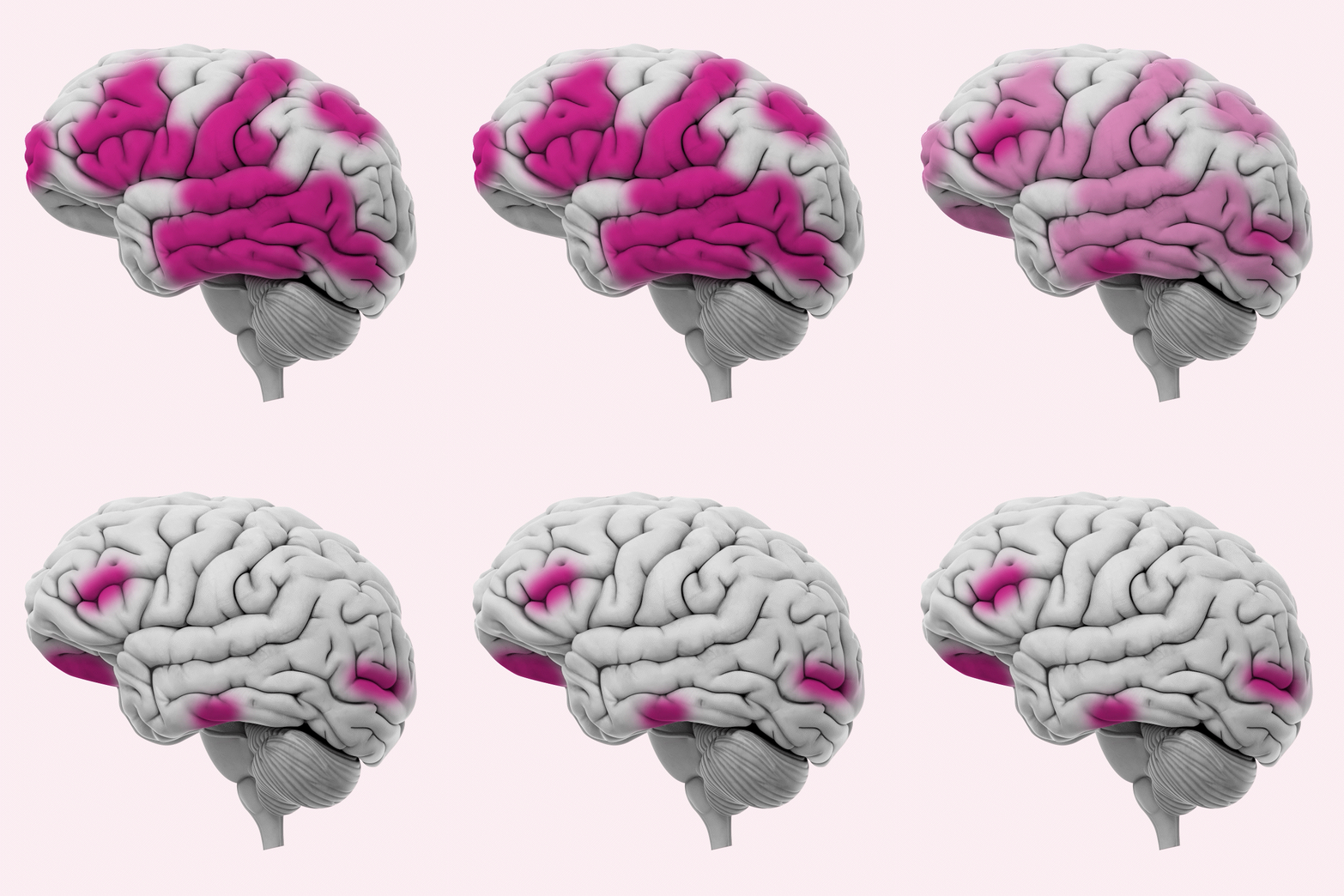
- In women with HSDD, deactivation of the medial orbitofrontal cortex can produce a decrease in PGG-POSC activation, causing absence of vaginal vasocongestion and lubrication and decreased sexual behavior in general.13
- Addyi is believed to increase dopamine and norepinephrine and transiently decrease serotonin, restoring an appropriate balance of excitatory and inhibitory activity of the brain reward centers to the prefrontal cortex.3 In animal and in vitro studies, flibanserin has shown 5-HT1a antagonist and 5-HT2a antagonist activity.3,7
The exact mechanism of action of Addyi is unknown.
How HSDD Alters the Female Brain
Mapping Sexual Desire
- In women with HSDD, deactivation of the medial orbitofrontal cortex can produce a decrease in PGG-POSC activation, causing absence of vaginal vasocongestion and lubrication and decreased sexual behavior in general.13
- Addyi is believed to increase dopamine and norepinephrine and transiently decrease serotonin, restoring an appropriate balance of excitatory and inhibitory activity of the brain reward centers to the prefrontal cortex.3 In animal and in vitro studies, flibanserin has shown 5-HT1a antagonist and 5-HT2a antagonist activity.3,7
The exact mechanism of action of Addyi is unknown.
The stress of HSDD goes beyond the bedroom.
33%
argue with their partner about their lack of desire for sex14
66%
feel less connected to their partner14
33%
worry their partner will cheat14
The stress of HSDD goes beyond the bedroom.
33%
argue with their partner about their lack of desire for sex14
66%
feel less connected to their partner14
33%
worry their partner will cheat14
Contact Us
MEDICAL INFO:
844-746-5745 x 4
medicalaffairs@sproutpharma.com
Contact Us
MEDICAL INFO:
844-746-5745 x 4
medicalaffairs@sproutpharma.com
- IQVIA Monthly Total Prescriptions Volume Data Comparing Addyi vs Vyleesi in the US. April 2024–April 2026
- Ryan KL, Arbuckle-Bernstein V, Smith G, Phillips J. Let’s Talk About Sex: A Survey of Patients’ Preferences When Addressing Sexual Health Concerns in a Family Medicine Residency Program Office. PRiMER. 2018;2:23. https://doi.org/10.22454/PRiMER.2018.728252
- Stahl SM, et al. Multifunctional pharmacology of flibanserin: possible mechanism of therapeutic action in hypoactive sexual desire disorder. J Sex Med. 2011;8:15-27
- Www.medicalnewstoday.com, 30 Nov. 2022, www.medicalnewstoday.com/articles/hypoactive-sexual-desire-disorder#overview
- Gerstenberger EP, Rosen RC, Brewer JV, et al. Sexual desire and the Female Sexual Function Index (FSFI): a sexual desire cutpoint for clinical interpretation of the FSFI in women with and without hypoactive sexual desire disorder. J Sex Med. 2010;7(9):3096–3103.
- Rosen R, Brown C, Heiman J, et al. The Female Sexual Function Index (FSFI): A multidimensional self-report instrument for the assessment of female sexual function. J Sex Marital Ther. 2006; 26:2, 191-208.
- Addyi Prescribing Information.
- https://www.fda.gov/drugs/drug-interactions-labeling/drug-development-and-drug-interactions-table-substrates-inhibitors-and-inducers
- Clayton AH, Harry AC, Yuan J, et al. Safety of flibanserin in women treated with antidepressants: A randomized, placebo-controlled study. J Sex Med 2018;15(1):43-51.
- Arnow BA, Millheiser L, Garrett A et al. Women with hypoactive sexual desire disorder compared to normal females: a functional magnetic resonance imaging study. Neuroscience 2009;158:484-502.
- Woodard TL, Nowak NT, Balon R et al. Brain activation patterns in women with acquired hypoactive sexual desire disorder and women with normal sexual function: a cross-sectional pilot study. Fertil Steril 2013;100:1068-1076.
- Bianchi-Demicheli F, Cojan Y, Waber L, et al. Neural basis of hypoactive sexual desire disorder in women: an event-related fmri study. J Sex Med. 2011;8:2546-2559.
- Holstege G. How the emotional motor system controls the pelvic organs. Sex Med Rev. 2016: 4;303-328.
- Kingsberg SA. Attitudinal survey of women living with low sexual desire. J Women’s Health. 2014;23(10):817-23
- Clayton AH, Brown L, Kim NN. Evaluation of safety for flibanserin. Expert Opin Drug Saf. 2020;19(1):1-8. doi:10.1080/14740338.2020.1707804
- Goldfischer ER, Breaux J, Katz M et al. Continued efficacy and safety of flibanserin in premenopausal women with hypoactive sexual desire disorder (HSDD): Results from a randomized withdrawal trial. J Sex Med.2011; 8:3160-3172.
- Jayne C, Simon JA, Taylor LV, Kimura T, Lesko LM; SUNFLOWER study investigators. Open-label extension study of flibanserin in women with hypoactive sexual desire disorder. J Sex Med. 2012;9(12):3180-3188. doi:10.1111/j.1743-6109.2012.02942.x
- Kornstein SG, James JA, Apfel SC, et al. Effect of flibanserin treatment on body weight in premenopausal and postmenopausal women with hypoactive sexual desire disorder: A post hoc analysis. J Women’s Health. 2017;26(11):1161-1168.
Important Safety Information
WARNING: RISK OF HYPOTENSION AND SYNCOPE IN CERTAIN SETTINGS
See full prescribing information for complete boxed warning.
- Use of ADDYI and alcohol together close in time increases this risk. Counsel patients to wait at least two hours after consuming one or two standard alcoholic drinks before taking ADDYI at bedtime or to skip their ADDYI dose if they have consumed three or more standard alcoholic drinks that evening.
- Use of ADDYI is contraindicated with strong or moderate CYP3A4 inhibitors or in patients with hepatic impairment.
Contraindications
- Moderate or strong CYP3A4 inhibitors
- Hepatic impairment
- Known hypersensitivity to ADDYI or any of its components. Reactions, including anaphylaxis, angioedema, pruritus, and urticaria have been reported.
Warnings and Precautions
- Hypotension and Syncope Due to Alcohol Interaction: See Boxed Warning.
- Hypotension and Syncope with CYP3A4 Inhibitors: See Boxed Warning and Contraindications. Concomitant use of multiple weak CYP3A4 inhibitors that may include herbal supplements (e.g., ginkgo, resveratrol) or non-prescription drugs (e.g., cimetidine) may also increase the risk.
- Central Nervous System (CNS) Depression: The risk is increased if ADDYI is taken during waking hours; with alcohol; with other CNS depressants; or with CYP3A4 inhibitors. Patients should avoid activities requiring full alertness (e.g., driving or operating machinery) until at least 6 hours after taking ADDYI and until they know how it affects them.
- Hypotension and Syncope with ADDYI Alone: The risk is increased if ADDYI is taken during waking hours or if higher than the recommended dose is taken.
- Syncope and Hypotension in Patients with Hepatic Impairment: See Contraindications.
- Hypersensitivity Reactions: See Contraindications. Immediately discontinue ADDYI and initiate appropriate treatment if hypersensitivity reaction occurs.
Drug Interactions
- Oral Contraceptives and Other Weak CYP3A4 Inhibitors: Increases flibanserin exposures and incidence of adverse reactions.
- Strong CYP2C19 Inhibitors: Increases flibanserin exposure which may increase risk of hypotension, syncope, and CNS depression.
- Digoxin: Increases digoxin concentrations, which may lead to digoxin toxicity. Increase monitoring of digoxin concentrations.
Most Common Adverse Reactions
- Most common adverse reactions (≥2% and higher than placebo) are dizziness, somnolence, nausea, fatigue, insomnia, urinary tract infection, anxiety, sinusitis, constipation and dry mouth
Please see accompanying full Prescribing Information including BOXED WARNING at ADDYI.com/PI
Indication
ADDYI is indicated for the treatment of women < 65 years of age with acquired, generalized hypoactive sexual desire disorder (HSDD), characterized by low sexual desire that causes marked distress or interpersonal difficulty and is not due to: a co-existing medical or psychiatric condition; problems within the relationship; or the effects of a medication or other drug substance.
Limitations of Use: ADDYI is not for use in men or to enhance sexual performance.